
Rodney DeCroo’s Night Moves focuses on the passing mysteries of city’s sidewalks — Stir
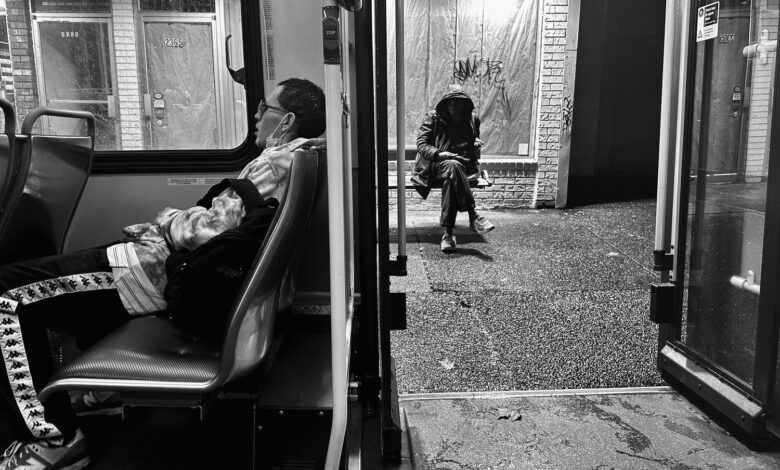
As DeCroo recalls at a table by the window of the Drive’s Continental Coffee House, the long, halting process of tuning his eye had many similarities to his discovery of the healing powers of writing poetry, which came about not long after he moved to Vancouver more than three decades ago.
“It’s no secret I had a fucking hellish childhood, and much of my early adult life was really troubled,” he says. “I struggled with addiction and struggled with alcoholism, and when I was younger I was violent, and I got arrested and went to psych wards. You know, my life was very difficult. And fortunately I found arts—which I found in this neighbourhood, sitting in this café.”
It was here, in conversations with young artists and writers, that DeCroo saw a way out of the circular chaos, not merely by reading poetry, but by taking on the hard, frustrating task of learning to create it.
“Suddenly, this idea that I could engage in making art gave my life some kind of direction and dignity and meaning, and something I could do—and I was terrible at it,” he says with a chuckle. “But then I got better at it. And then I got better at it enough that people got interested, and then opportunities came to share it. And I think I got addicted to that process. So then I went, ‘Okay, I did that with poetry, let’s do that process with music.’ And so I got really into making songs.”
This entailed taking up the guitar at the age of 30 and hammering away at the basics of the instrument until they began to produce the kind of fierce, weathered songs that have since filled eight widely admired albums. DeCroo’s tolerance for sitting with early limitations and then slowly, relentlessly erasing them is extraordinarily high—a trait he attributes to an “obsessive” streak.
“And now I’m like, ‘Okay, I’m going to do this,’” he says, referring to his early attempts at turning his smartphone’s camera to the street. “There’s something about starting a new discipline and knowing you suck—like, knowing how bad you are. That turns me on—that excites me. Because it’s like, ‘I’m going to stick with this and then watch the pieces start to slowly come together, and then reach a degree of competency.’ You have to really grind. You have to invest yourself in that. But I’m a fucked-up guy, and so investing myself in something like that is really good for me. Because I’m not having relationships. I’m not having kids. I’m not buying a house. I’m making art—that’s what I do. I wake up in the morning and I make art.”
This full, hard-won fluency with the camera is now clear in the images of Night Moves. Each instant is like a story interrupted, the immediate past and future stretching away in the viewer’s imagination.
And as images made in the public bustle and without formal permission from their subjects, they inevitably raise questions of exploitation that have haunted street photography from the beginning of the form. Again, the first poem in Night Moves confronts the matter directly: “Some days/I’d take a shot and the person would say Hey,/fuck you, don’t take my photo! I’d forget/as they stood with knuckled fists and spit/flying into my face that I owed them an apology,/for I’m a thief of their dance with time.”
In conversation, DeCroo readily admits to experiencing this innate conflict in street photography as a source of energy. “I work off of tension,” he says. “Whenever there’s tension, there’s something dynamic happening….I think you never completely resolve that dilemma that photography presents. But I sort of like that. I hope that doesn’t sound perverse. But I feel it keeps it alive.”


