Review of George Packer’s dystopian novel, ‘The Emergency’
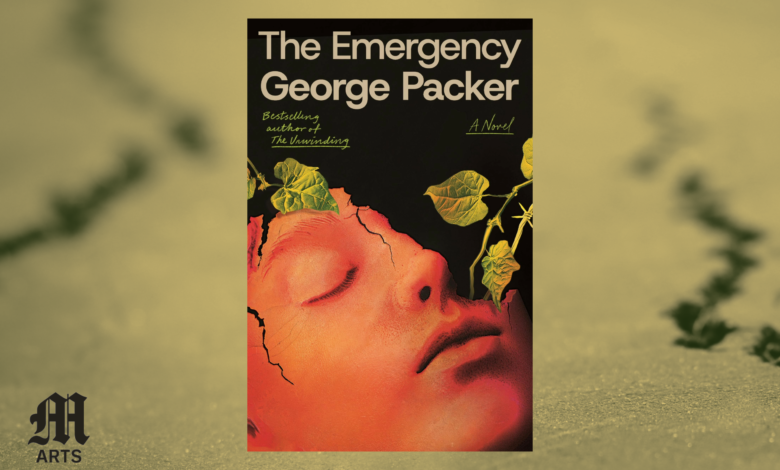
Given today’s extreme polarization and highly politicized media climate, I approached George Packer’s new dystopian novel, “The Emergency,” with caution. While I recognized Packer’s name from his extensive nonfiction work and writings for The Atlantic, the novel’s synopsis, which describes a rebellion involving “urban Burghers” and “rural Yeomen,” made me hesitate. Would this novel be another thinly veiled political message, glorifying one side and villainizing the other? Would it all be too obvious?
Dystopian fiction is difficult to do well. As I parse through most dystopian fiction, I usually find myself in one of two equally frustrating positions. In the first, I orient myself in the authors’ world with ease. Once I identify the characters and get a good grasp of their world, I begin labeling: I see, these must be Democrats, and these ones must be Republicans. This guy must be like Jeff Bezos. And so on. While this can certainly be interesting and entertaining, it is often shallow and predictable, leaving little room for nuance and unique angles. Alternatively, in the second position, I find myself utterly confused, lost in a world that looks and sounds nothing like my own and gives me nothing new or valuable to think about.
However, every once in a while, a good dystopian novel strikes the perfect balance between these two traits; “The Emergency” is one of these novels. What Packer is trying to tell us about our world is neither too obvious nor too ambiguous. Despite the occasionally inhumane behavior portrayed in the novel, Packer usually approaches all of his characters with empathy, showing readers where we can do better.
The novel begins at the end of an empire, historically split into two socioeconomic groups: Burghers and Yeomen. The Burghers live in the city, working in jobs determined by both their inherited family guild and their performance in a strict examination. Those who fail the examination become “Excess Burghers,” destined for a life of homelessness, drinking and, if they’re lucky, menial labor. Yeomen, on the other hand, live outside the city in rural villages. They farm and provide food for themselves and the Burghers in the city. They have practical knowledge but less formal education than Burghers. Before the fall of the empire, Burghers and Yeomen lived separately, performing separate tasks in a supposed state of harmony called “Good Development.”
After the fall of the empire, however, the city is taken over by a group called “Together” who reject the high-pressure examination and hierarchical guild system. Led by the young, Together restructures the once highly organized city into small self-organized groups, emphasizing equality. Everyone in the city is included, excluding the Yeomen, who are villainized by the group.
Amid all the change, Dr. Hugo Rustin, a Burgher, finds his livelihood and personal ethical code challenged. Rustin firmly believes in the guild system and “Good Development.” Moreover, his personal ethical code, which he calls “humanism,” relies on his belief in the power of shared humanity and empathy for Burghers and Yeomen alike. When this idealistic and occasionally arrogant philosophy puts him at odds with Together, he embarks on an adventure to the rural Yeomen villages in an attempt to reaffirm his faith in humanity.
The novel, told from the perspective of Rustin, his wife and their daughter — all Burghers — follows both Burghers and Yeomen as they distance themselves from each other and eventually from humanity itself. It explores both life in the city, in the rural Yeomen villages and in between. It asks the questions we consider about ourselves in our personal and political lives: What does it mean to belong? To grow up? To protect a family?
“The Emergency” also explores another question that permeates contemporary life: How can someone believe something to be true that I know to be false? By exploring the stories that both Burghers and Yeomen tell about each other, Packer explores the way echo chambers create “truth” and how sensationalized stories spread, sometimes completely off base and sometimes capturing some truth. He examines the false realities we live in (and even consciously accept) and the motivations and insecurities that lie beneath them.
Packer doesn’t answer these questions for us. “The Emergency” doesn’t end with a solution to division, echo chambers and polarization. It simply reminds us to remember our humanity. It doesn’t side with the Burghers or the Yeomen or condemn the naivete of its characters. It is a well-wrought, colorful and interesting story which asks us urgently to spend time with these questions and figure them out for ourselves — before it’s too late.
Daily Arts Writer Claire Rock can be reached at rockcl@umich.edu.
Related articles
Source link