A Total Breakdown of All the Easter Eggs | A. S. Hamrah
In December 2019, three months before the pandemic, I was standing on a subway platform in Brooklyn when I recognized a prominent older film critic also waiting for the train. I had been reading his work for many years, so I decided I would introduce myself. It can be awkward or presumptuous to bother a stranger like that, but he didn’t seem to mind. He was polite and engaging. It turned out that we lived in the same neighborhood, and later, after he’d read my book The Earth Dies Streaming, he emailed and we arranged to get breakfast.
We met in a tiny café with tables the size of half-dollars. We discussed filmmakers, film festivals, and other critics, and it was all very pleasant, though we were sitting at a table too small for two grown men to be eating at. As we left the café, we headed down the street in the same direction. “Scott, you’ve written a very good book,” he said as we approached the intersection where we would part ways. “But writers could be film critics in this country from the 1940s to the 1980s. Not anymore. See ya!”
With that mic drop, he turned in the direction of the good part of the neighborhood where he lived. Awed by his restraint in not adding “don’t quit your day job,” I carried home the two books he’d given me, one he’d written and one he’d edited. Naturally, the period in which he said writers could be film critics in this country overlapped with his heyday. Still, I was somewhat dazed by the finality of his statement. Film criticism? Over. O-v-u-r, as it says at the end of the Jerry Lewis movie Hardly Working. A reason to continue? Not that he’d mentioned.
This encounter was a foreboding way to end the year 2019, but at the time I had other things to think about. Soon after that breakfast I was introducing Cocteau’s Orpheus at the Quad in Manhattan and then, early in 2020, flying to Seattle to do the same for John Sayles’s Matewan and to sign books at a bookstore. As far as I was concerned, film criticism was doing fine. On my flight back to New York there was one person wearing a face mask on the plane, a man in his twenties. The mask was in a camouflage pattern. I thought to myself, “he’s taking this coronavirus thing pretty seriously.” I heard other people seated near me in the cabin wryly pointing him out to one another with a “get a load of this guy” attitude. A couple weeks later movie theaters all over the country closed down. A lot of them remained shut until 2021, and many went out of business. Film criticism became something done at home, like baking bread.
These days when I think of 2019, what often comes to mind are Quentin Tarantino’s remarks from the 2025 Sundance Film Festival, the second-to-last one that will happen in Utah, where it was founded by Robert Redford, recently deceased. “What the fuck is a movie now?” Tarantino asked. “Something that plays in theaters for a token release…and by the second week you can watch it on television. I didn’t get into all this for diminishing returns…. It was bad enough in 2019, and that was the last fucking year of movies.” Tarantino, who had debuted Reservoir Dogs at Sundance thirty-three years earlier, ended his thoughts on this subject by claiming that theatrical releases of movies had become “a show pony exercise” designed to market films for the streamers.
As many literal-minded people pointed out, 2019 was not in fact the last year of movies. Many good films have been made since then. Last year great films from all over the world were released in the US. A random list of disparate and original films seen on American screens in 2024 includes La Chimera, About Dry Grasses, Christmas Eve in Miller’s Point, The Settlers, A Different Man, Universal Language, and, yes, Megalopolis. One of the best movies of the year summed it all up, not just in its title but in subject matter and style—in its whole approach to what a movie is and can be in the mid-2020s: Radu Jude’s Do Not Expect Too Much from the End of the World. It’s a film about a certain kind of filmmaking being done under certain conditions that seem, in their way, more perilous than the ones under which Furiosa: A Mad Max Saga was made.
I think 2019 will come to be seen in film history as a golden year and an inflection point, the same the way 1939 and its movies exist in the popular imagination as a series of classics constantly open to new investigation and debate—not just The Wizard of Oz and Gone with the Wind and Mr. Smith Goes to Washington, but also The Rules of the Game (of course), Only Angels Have Wings, Ninotchka, Love Affair, Stagecoach and Young Mr. Lincoln, and at least a couple dozen others. The 2019 version of this inventory includes Parasite, The Irishman, Uncut Gems, Tarantino’s Once Upon a Time in Hollywood, The Souvenir, Ash Is Purest White, Portrait of a Lady on Fire, and as in 1939, a number of other films whose reputations will grow and wane and grow again—Peterloo, Atlantics, La Flor, Midsommar. The films of 1939 arrived at a time of burgeoning right-wing authoritarianism, and 2019 was similarly set on a precipice. Its films already seem the product of a different world. As it says onscreen in a film made at another turning point in history, “That era has passed. Nothing that belongs to it exists anymore.”
I have a strange relic from that vanished year that I’ve managed to hold onto. It’s a Cats drink ticket. All the critics who attended the Cats press screening at the Landmark at 57 West in Manhattan on December 17, 2019, got one. Universal had little understanding of what they had done in adapting the Andrew Lloyd Webber musical to the screen. They didn’t know that they had produced the worst film of the year, maybe the worst of the decade, maybe the worst ever. So little did they understand any of this that they were providing an open bar after the press screening. Each critic who received one of the golden-colored tickets was entitled to “One (1) Complimentary Wine, Beer or Specialty Cocktail Courtesy of Universal Pictures.” The idea, presumably, was that, having been delighted by Cats, the critics would gather at the bar to trade superlatives about Tom Hooper’s direction and Idris Elba’s and Judi Dench’s performances as singing felines, causing them to write sparkling encomia to the movie, which would then lead to big box office over Christmas.
I saw Cats with another film critic who was as appalled as I was when this bizarre, terrible movie ended. When we exited the theater and I suggested we go to the open bar, she wasn’t having it. Nobody was. Not one critic stopped to use their drink ticket. It was as extraordinary as Cats itself, with its horrifying costumes and repellent cat-face makeup and its dancing cockroaches, with Taylor Swift and her CGI body and Jason Derulo as Rum Tum Tugger. Writers turning down free drinks. Another ominous sign for the new year.
The Landmark at 57 West, a huge, state-of-the-art eight-screen cineplex ridiculously located far from any subway stop, closed for good in the summer of 2020. Cats awaits rediscovery as a cult item, but in the meantime, more than any of the 2019 films that qualify as new classics, it looks like the kind of movie made for streaming services that tell us their movies have been watched by 300 million people and are number one on their weird charts, having broken every made-up record they can think of.
Recently I watched a clip on YouTube of Woody Allen’s appearance on Bill Maher’s Club Random podcast. Allen was there to act as a second banana while Maher railed against cancel culture. Maher seemed agitated and vulgar compared to Allen, who came across as meek and old and like he would rather have been somewhere else, with someone who was not drinking from a large bottle of tequila.
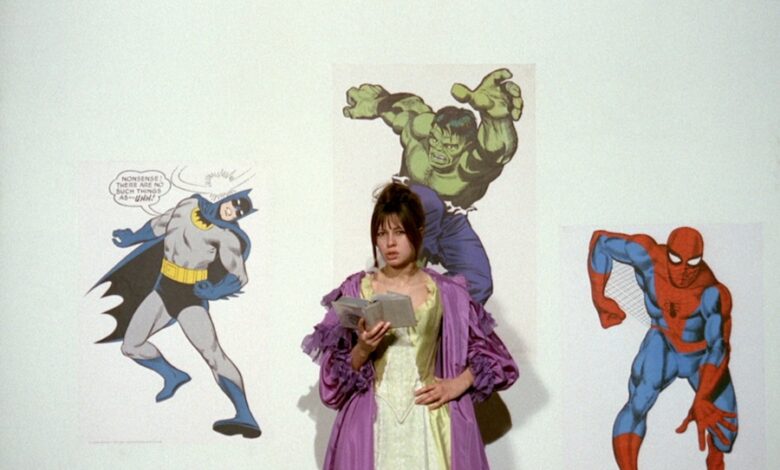
Allen, director of one of the essential movie-theater films, The Purple Rose of Cairo, mentioned that he prefers to see movies in theaters, that that has always been his thing. That’s what he makes films for, he said—to show them in theaters, to large groups of spectators all at once, not to isolated viewers at home. Maher reacted poorly to this. “You know this is a civilization gone with the wind?” the talk show host smirked, explaining to a director who has been in the film industry for seven decades that he could get a lot more people to watch his movies if he made them for streaming television. Since Allen had already tried and failed to do so with an Amazon series starring Elaine May and Miley Cyrus, it probably would have been better not to bring that up.
As one of our more strident baby boomers, however, Maher could not help himself. He was compelled to voice an attitude that has contaminated his generation. A famously tech-loving cohort with money to burn, they have celebrated every new technology, right up to artificial intelligence, and presumably they will love the death robots because they, Immortan Joes all, will be in charge of them. As part of this new regime of anti-human technology, it has become imperative for them not only to believe that no one goes to the movies anymore, but also to mention this every time the subject of current movies comes up. It has to be true for them in order for their total capitulation in the face of tech not to become obvious as what it is: evidence of their own cultural stagnancy. The continued existence of the cinema threatens their supremacy in the desiccated cultural life of our time. Saying at every opportunity that no one goes to the movies justifies their lack of interest in the possibility of new ones being good. They haven’t heard of them. If good ones were being made, they’d somehow just know, without expending any effort.
This attitude plays into the hands of the right, whose obsession with being anti-Hollywood extends to a generalized hostility toward moviegoing. Whenever a celebrity says something the right doesn’t like, a thousand social media posts appear announcing that “I haven’t seen a movie in a theater in over eight years,” or, more likely, ascribing a lack of interest to others: “This right here is why sooo many people checked out of watching anything Hollywood creates.” Both of these are tweets I found in two seconds, the second from someone announcing his age and status (unless he’s a bot): @silverfoxlife.
Or maybe this brand of generational solipsism is just a sign of age. Éric Rohmer, of all people, was not immune to it. In a documentary about him called Moral Tales, Filmic Issues, made in 2006, when he was eighty-six years old, Rohmer says the following to Barbet Schroeder, his interlocutor:
I’ll admit, some people might be outraged, but I don’t go to the movies anymore. I can appreciate a film more, and judge it better, if I see it on video instead of in the movie theater. This is due to my age. I’m getting a bit claustrophobic and my eyesight is… I’ve lost the knack of choosing a seat at the right distance from the screen, because often I can’t get to that seat and I can’t sit just anywhere. That’s why I prefer a film on video, despite what certain purists think.
The difference is that Rohmer, as one would expect, is wise enough not to make his preference into a universal fact. He “admits” he does it; he does not say it’s better or that now nobody does it any other way.
Too often film critics get defensive about this screen agnosticism, responding to their implicatedness with non sequitur and cliché. Yes, cinephiles want to see everything all at once, for free if possible, and there are ways to do that from home or on the go. It’s true that in most of the country there are fewer theaters showing fewer movies, and the local rep house is too often hosting a sing-along screening of a musical. Martin Scorsese saw a lot of films for the first time on TV, and Truffaut wrote that if a film is good, its quality comes through even on a small black-and-white TV.
So what? We’re always being told that for decades now most people’s introduction to cinema has been via a TV screen or a computer screen. This is a truism. Repeating it gets us nowhere. And making a point of defending it is counterproductive to the future of cinema. Whenever David Lynch’s cri de coeur against watching movies “on your fucking telephone” circulates online, it is met with hostility from certain people. As beloved as Lynch is, some of his viewers treat his assessment as an insult to their lifestyle choices. The implication of their overreactions is clear: a defense of laziness, convenience, and (cinephagic) gluttony—things they probably don’t like in other people.
It is possible that the people who go to the movies less than anybody else, and who watch the fewest number of films, are members of the Hollywood film industry and the entertainment journalists who cover them. Binging once a year on for-your-consideration screeners of awards-nominated movies is also unhealthy. And since many of the people tasked with voting on awards don’t actually watch all the movies under consideration, in 2025 the Academy of Motion Picture Arts and Sciences had to impose a rule requiring that voters in the industry watch all the Oscar-nominated films in their category to be eligible to vote on them. The rule doesn’t insist they watch the whole movie, however, as that would be a crazy imposition on people already busy giving hearts to @emrata on social media while the film under consideration runs in the background.
In a recent interview with The New York Times, one of our most anti-cinema and TV-centric publications, Reese Witherspoon asserted that “usually people are seeing one movie a year in the theaters with their kids.” When the Times reporter asked Witherspoon if there was a cognitive shift in attention spans being led by artificial intelligence, one that was causing decreased theater attendance in younger people, the actor-producer replied, “everybody knows it.”
This is nonsense. First, the genres on which movie theaters reliably make money year after year are kids’ movies, family movies, and animated movies. Box office stats bear that out. Second, if the reporter meant teens, what is unquestionably keeping most of them away is the rising price of theater admissions, coupled with a growing lack of employment opportunities for them to make money to spend at movie theaters. As for what “everybody knows” about artificial intelligence, that’s another story. Yes, if AI takes over film production, audiences will stay away. That has nothing to do with attention spans and everything to do with the quality of the product that will emerge, something the studios are betting won’t matter, or don’t care about because their interest in theatrical exhibition has waned. Witherspoon adds that it is a waste of her time to try to get movies made that the studios won’t greenlight. If even before the pandemic you were acting in or producing movies like A Wrinkle in Time and Lucy in the Sky, it makes sense why you might not bother.
The more these views are asserted, the more the box office has pushed back. It is to be remembered that Warner Bros. was so convinced that Ryan Coogler’s Sinners wouldn’t do well that they gave him a piece of the action (first-dollar gross and licensing rights). WBD then looked on bashfully as the Penske entertainment press (Variety, the Hollywood Reporter, Deadline, Gold Derby) recoiled in horror on the studio’s behalf at Sinners’s success and the money Coogler was making.
When Revenge of the Sith and Jaws were rereleased this year on their respective twentieth and fiftieth anniversaries, they cleaned up at the box office, despite being available streaming. But being number one at the movies is still not enough for Smilin’ Ted Sarandos to press pause on his endless sales pitch for staying at home. Releasing movies in theaters, said the Netflix co-CEO as moviegoers lined up to see decades-old films, is “an outmoded idea for most people.” One wonders who Sarandos means when he talks about most people. As early as 1954 the powerhouse screenwriter Ben Hecht was referring to Americans as “the TV watchers,” and he hardly considered that a reason to destroy theatrical exhibition. But he wasn’t a co-CEO.
In the publicly traded world of Netflix and the breathless business reporting that follows it around, the growing success of arthouses and revival houses is an inconvenience best ignored. Since news reports about the resurgence of these movie theaters cannot compete with stories about big tech and its oligarchs, and now their obsession with AI, it’s understandable why news of the continued existence of moviegoing has not permeated public consciousness. Widespread disbelief in the cinema is not amenable to hearing about it.
Yet over the past two years there have been many stories in the news about this very phenomenon. A headline in The Telegraph on November 24, 2023 read “Old films, new fans: inside the repertory cinema boom.” From Screen Daily on February 20, 2024: “Why it’s boom time for theatrical re-releases of classic films.” NPR’s Marketplace announced on June 27, 2024 that “Indie theaters are using repertory films to stay afloat.” The website Adolescent on December 31, 2024: “The Remarkable Movie Theater Boom of 2024.” The Christian Science Monitor, two months later, on February 27, 2025: “‘I didn’t know I needed it.’ Why neighborhoods rally to save moviehouses.” The Silver Spring, Maryland, news site Source of the Spring on March 6, 2025: “How AFI Silver and Maryland’s Independent Theaters Are Thriving Amid Nationwide Closures.” The Orange County Register the next month, on April 1, 2025: “Across the region, repertory cinema is cool once more.” This all culminated in a piece on Sequoia Capital’s controversial investment in Mubi (controversial because of Sequoia’s ties to the Israeli military) in the Financial Times on May 31, 2025, in which the paper explained that Sequoia’s investment was a response to the “rising global demand for art house cinema.”
It is Hollywood that has ceded this ground. The studios don’t make enough movies anymore. The big exhibitors have responded by booking movies from outside the pipeline of traditional suppliers: Christian movies, right-wing documentaries, and Bollywood hits.
But the exhibitors are part of the problem too. In Kleber Mendonça Filho’s 2023 documentary, Pictures of Ghosts, about his life as a moviegoer in his hometown, Recife, on Brazil’s northeastern coast, Mendonça refers to movie theater marquees as “timepieces,” because they so often show up in the backgrounds of photographs, which can be accurately dated by the release dates of the films playing at the theaters, their titles visible on the marquees. Marquees allow us to link pictures to certain dates, to periods in our own pasts and to history in general.
I drove by a fifteen-screen Cinemark multiplex in West Springfield, Massachusetts recently. This Cinemark had replaced the marquee with a huge billboard extolling the comfort of the seats in the theater. It made the building look like a chair factory. I guess this makes sense for places where the concession stand now sells two-person lap blankets, “the perfect co-star for any movie.” For the full airline experience, they could sell eye masks and ear plugs, too. Forget about the marquee. Why see the movie at all?
During the pandemic, when the studios were convinced moviegoing was a thing of the past and streaming had a headlock on the future, it became clear to them that the value of movie stars was linked to screen size—that stars were paid by the foot. So if a movie star appeared in a movie theater on a forty-foot screen, maybe they had to be paid $20 million. But what if their images could literally be cut down to size? On a two-foot screen at home, maybe they were only worth $2 million. And what about on a six-inch screen on a smartphone?
Scarlett Johansson sued Disney over a variation on this kind of thinking. When her 2021 superhero-starrer Black Widow was released simultaneously in theaters and on streaming because of the pandemic, she got her $20 million base salary but lost all the pay that, per her contract, was tied to box-office performance. She and Disney settled out of court, with the Mouse reportedly compensating Johansson for her lost earnings. Now streamers like Apple still have to pay stars like George Clooney and Brad Pitt in the low-to-mid eight figures for Wolfs, a movie that played in theaters for a week and then went to the studio’s streaming channel, where it was watched by few and discussed by fewer, while the streamer touted it as the most popular movie it had ever made.
High salaries for actors contribute mightily to the studios’ disappointment in the continuing success of a collective medium they would rather control at every stage in the process. Never in the history of cinema have producers had more power than they do now. Digital shooting and computer-generated images, coupled with AI, mean that every image falls out of the hands of directors and cinematographers and fully escapes the actors directed and photographed by them. If the studio owns the movie and there is no final cut in the director’s contract, then there is no final cut, ever.
“While we are extremely proud of what’s on the screen,” Bob Iger, Disney’s CEO, said in 2023, “it’s gotten to a point where it’s extraordinarily expensive.” This from a company with almost $5 billion in net income in 2024, due in large part to theatrical revenue: Disney was losing money on streaming until the second half of that year, which it ended with a total streaming profit of $134 million. To put that in perspective, Iger’s “total compensation” in 2024 was $41 million, up about 30 percent from his 2023 package of $32 million.
With this kind of system in place, it is easy to see why studios are so eager to fully automate. Iger has mentioned that filmmakers in Hollywood must “embrace the change” represented by AI. Some actors, including Johansson, have come out against AI, but others will be happy to lease or sign over their voices and faces for future animated product that can be used the way the late Peter Cushing is used in Star Wars product. James Earl Jones, the voice of Darth Vader, did exactly this before he died in 2024, ensuring that all future iterations of Vader will speak as the original. As I was writing this, an AI company announced that one of their creations, an AI-generated actress they call Tilly Norwood, had attracted the attention of talent agencies that were now trying to sign her, or it.
The new kind of fake actor will be a total reversal of the way movie stars have been seen throughout film history. In his 2023 biography of the Chinese American actor Anna May Wong (the only Hollywood movie star to ever make it onto US currency—her face appeared on an “American Women” series of quarters in 2022), Yunte Huang includes a trip Wong took to her father’s hometown in China in 1936. People she met there were shocked to learn that she was a real person who actually existed. “They had seen me on the screen, but they thought I was simply a picture invented by a machine,” Wong wrote at the time. We should now prepare for the opposite of this kind of confusion. Some people will come to think that movie stars who don’t exist are real.
Iger’s plan is in motion at Disney. We can bet that he will continue to lay off staff and push for automation while at the same time emphasizing what he calls “quality” over “quantity.” Thus the upcoming releases from Disney are Toy Story 5, Zootopia 2, Frozen III, The Incredibles 3, The Mandalorian and Grogu, Avatar: Fire and Ash, and Tron: Ares. It reminds me of a tweet from HBO Max (when it was called that the first time, before they renamed it MAX and then changed it back) about a forgotten movie they made in 2020 called Superintelligence, with Melissa McCarthy and disgraced talk-show host James Corden as the voice of evil: “An all-powerful A.I. decides humanity’s fate—and it’s hilarious. Sign up now to stream.”
Iger has explained that politics is bad for business: “the bottom line,” he says, “is that infusing messaging as a sort of number one priority in our films and TV shows is not what we’re up to.” Their films and TV shows instead “need to be entertaining.” According to NBC News, one of Disney’s problems is that “many audience members began to feel that the company’s content had grown overly existential and too concerned with social issues beyond the reach of children.” Who were these audience members? I don’t speak with many children, but I haven’t heard any of them say they are leaving recent Disney and Pixar movies in a state of confusion and dread.
An unwillingness to come up with new material and an inability to sell it to audiences is a strange idea of what constitutes quality. It makes a virtue of playing it safe. It is a kind of filmmaking born of cowardice. Iger’s version of “quality over quantity” is also appealing to those who approve corporate mergers in Washington. If Paramount Skydance can try to buy WBD, maybe Disney can absorb Universal. Then Sony and Lionsgate can merge, reducing Hollywood to three major studios making maybe forty-five movies a year.
Given their goals, which require government approval, it is amazing that after pulling Jimmy Kimmel and his late-night talk show off the air, Disney let him back on. Maybe the only people Iger fears more than the Trump administration are Hulu subscribers, who can cancel their streaming subscriptions. The trade-off is clear, however. The government wants to control TV news; owners of local affiliates want to consolidate; and the studios want to consolidate, too, just as Disney took over Hulu. This circle represents the death of knowledge and art in an age of extreme wealth inequality, a new paradigm that will generate garbage with as little human involvement as possible.
In Franz Kafka’s story “In the Penal Colony,” which is about an automated torture device, Kafka writes that “we used to have to adjust a few things by hand, but from now on the machine will work all by itself.” I think this is exactly what people dread about AI and why they recoil from it, and also why large corporations are so excited about it. It is an aspect of the kind of fascism Kafka predicted. It removes the human element from the cinema just as the tech industry in general is removing showbiz from entertainment.
Here the news, entertainment, and the government all merge into a pool of toxic sludge. Because of AI, we could already picture a future in which another pandemic happens while we, as a species on lockdown, pass the hours in isolation viewing subpar art made by hallucination-prone nonentities. Today, videos of ICE raids scored to AI-generated nü-metal songs follow AI-generated jpegs of Donald Trump as Colonel Kilgore in Apocalypse Now, calling to mind “Ride of the Valkyries” from that film’s score, solidifying the connection to the Wagner-loving Third Reich. We live under a mode of dehumanized production where the most human element is the images of dead Palestinians that show up in our feeds between the latest iterations of the official slop.
Young cinephiles have traveled a strange road in the twenty-first century, much to their credit. In general I think their trajectory went in this direction: a childhood of repeated exposure to animated family movies from Hollywood, occasionally enlivened by a Miyazaki, then onto violent, ugly horror films—the new ones also mostly made in Hollywood, the adolescent flipside of the kids’ movies. And then, right after that: Salò, or the 120 Days of Sodom. With Letterboxd reviews.
In all likelihood Letterboxd will eventually go the way of other social media into a Salò-esque enshittification. It can also promote a certain degree of grade inflation: I have witnessed Letterboxd users announcing that they give every movie five stars because filmmakers try so hard. But nothing creates a herd mentality among critics like the Roll Call of Shame that is Rotten Tomatoes. In the world of film criticism there is nothing sadder than seeing the phrase “Tomatometer-approved critic” in somebody’s bio. I don’t understand why critics seek approval from this content aggregator, owned by Comcast and WBD, which takes and republishes their work for free. (They approved me without my asking and I have occasionally sent in corrections to their evaluations of my work because once they claimed I thought The Magnificent Ambersons was “rotten.” A scarring thing to see next to your name.) At least with Letterboxd we are not yet seeing actual news headlines like “Guardians of the Galaxy Vol 3 Rotten Tomatoes Score Revealed.”
Most mainstream film criticism is of the average Rotten Tomatoes variety. Film critics prior to the twenty-first century existed to draw in readers and increase circulation. Their pieces often appeared in the final pages of magazines because many readers started from the back. This was one of the secrets of Pauline Kael’s success and influence. Newspaper (and later TV) critics like Gene Siskel and Roger Ebert had a voice because they were engaging figures and struck readers as honest. Readers of hometown Chicago dailies often read them first when they picked up the paper.
Critics had personality, style, originality, wit, and deep knowledge borne of seeing many films, but for the most part publishers replaced them as they retired or died with people who could always be counted on to tell readers that Good Time was a bad movie and Three Billboards Outside Ebbing, Missouri or 1917 were good ones. I think of these critics as fake humanists, devoid of any of the values or pleasure I expect when I read film criticism.
The confluence of digital projection, streaming channels, AI, and the alleged death of criticism often makes it seem like we are dealing with the destruction of a worldview. I believe that this is indeed the goal of the corporations that control the studios and publishers. I don’t think it means that people don’t want to read criticism. What they don’t want to read are writers who are afraid of their editors, who curry favor with Hollywood, and who want to be influencers. Critics like that don’t consider one of the most important and necessary things about criticism today, that “struggle,” as Noam Chomsky put it, is always a matter of fighting “the business world.”
That should be foundational. The novelist Don DeLillo said the same thing in 2005, in an interview with a French horror-film magazine:
Writers must oppose systems. It’s important to write against power, corporations, the state, and the whole system of consumption and of debilitating entertainments…. I think writers, by nature, must oppose things, oppose whatever power tries to impose on us.
It is significant that the author of Libra mentions “debilitating entertainments” (and only seventeen years before the Netflix version of White Noise came out). Studio product is too often wearying. There is a great sense of defeat that the new, would-be monoculture instills in all but the most here-for-it. We have to write against that. We can both “await the end of cinema with optimism” and understand film’s value at the same time. There’s a song by Momus called “What Will Death Be Like?” that is more about what death won’t be like. “Death will be unlike the sea as it thunders on Liv Ullmann vanishing under the rollers,” Momus sings. I know “the rollers” refers to the ocean waves in the movie The Emigrants, but when I hear it I always picture the rollers in a movie projector guiding the film between reels.
Source link