
Prosperity in a Fractured World: Book Release Event Featuring Author Dani Rodrik and Colleagues
In an increasingly interconnected yet profoundly fractured world, nations everywhere face shared challenges. Among them, climate change, the erosion of democracy, and persistent poverty have proven particularly complex and urgent. CID Faculty Affiliate and Director of the Reimagining the Economy Project at Harvard Kennedy School, Dani Rodrik, delineated a vision of globalization which highlights green transition for a sustainable environment, a strong middle class that can bolster democracy, and economic revitalization that can curb poverty in a presentation centered around themes from his new book, Shared Prosperity in a Fractured World.
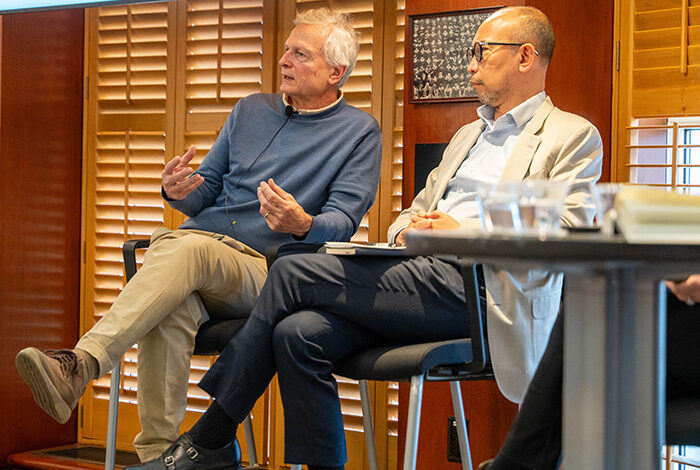
Rodrik outlined how promoting green energy, middle-class jobs, and productivity in labor-absorbing services is feasible through collaborative public-private action, even in the absence of global cooperation. For this event, Rodrik was joined by Muhamad Chatib Basri, former Minister of Finance of Indonesia; John Cassidy, staff writer at The New Yorker; and Rebecca Henderson, professor at Harvard Business School.
The World is Confronted with Three Essential Problems
Rodrik identified three important economic challenges that the world is currently facing—addressing climate change, rebuilding the middle class, and global poverty reduction. While climate change is a threat to our very existence, the lack of a strong middle class endangers our social and political survival. Rodrik discussed research which has established that democratic backsliding and rising authoritarianism is closely linked to a general weakening of the middle class. Furthermore, while progress had been made with the rapid reduction in global poverty rates in the decades prior to the Covid-19 pandemic, the headwinds following the pandemic have curbed progress.
These challenges pose grave concern for advanced and developing nations alike, and their urgency is unmistakable. A key concern that Rodrik identified is the lack of cooperation in addressing these issues. Existing policy frameworks tend to treat these domains—climate change, the erosion of the middle class, and enduring poverty—as contradictory or in tension with each other. They claim, for instance, that addressing climate change or strengthening the middle-class in advanced countries could curtail growth and trade opportunities for developing countries. This perspective presents an impasse that hinders meaningful progress. Despite the absence of tangible collaboration in tackling these global challenges, Rodrik searches for grounds for optimism.
Green Policies Offer Optimism
According to Rodrik, the “the single most important reason to have some optimism” lies in the green energy transition and the rapid decline in the price of renewable energy. He described this cost reduction as a “China story.” What made the industrial policy of China such a resounding success was various policies being implemented cohesively at all levels of the Chinese government—national, provincial, and municipal. These incentivized investment in renewables, brought learning costs down, and decreased prices. Rodrik believes this transformation can serve as a blueprint for addressing other challenges as well.
While Chinese industrial policies are associated with authoritarianism and a top-down framework, the green energy transformation was carried out in a more transparent and flexible fashion. The process was characterized by a wide range of instruments and collaborative policymaking. The government worked together with private businesses and localities, engaging in ample policy experimentation, which was “orthogonal” to—not dependent upon—the authoritarian nature of government. Henderson echoed the promising nature of the Chinese model, saying that technology does not set its own course. She argued that even the history of the U.S. in the late 19th century and following the Second World War was characterized by aggressive industrial policy, which was sustained by a strong social contract.
Services Will be the Impetus Behind a Strong Middle Class and Productive Jobs
The success of green policies is important in contextualizing how to approach other domains. Rodrik contended that it is first crucial to understand where new jobs will emerge. For both advanced and developing countries, according to him, the answer will not be manufacturing. While China is experiencing deindustrialization, those jobs in manufacturing are not moving to the developing world. This necessitates a focus on enhancing productivity within the services sector. But how can productivity in services be increased, especially considering widespread jobs that are unproductive such as healthcare aids and fast-food workers? Rodrik contended that DARPA or ARPA-style institutional forces that focus on worker-friendly technologies can help emulate the success of the Chinese green industrial transition at a national scale.
In exploring the mechanisms of services productivity, Henderson distinguished between the macro-environment—the “big picture” of national politics and global economic forces—and the micro-environment of individual and firm-level decision-making, emphasizing the latter’s crucial role. According to her, a key element in fostering low productivity firms is adherence to high performance work practices, which entail treating employees with dignity, devolving power, promoting on the basis of merit, and establishing a sense of shared purpose. In that sense, the new economic paradigm the world needs are characterized by “the skillful uniting of love and power.” Basri emphasized how Rodrik’s book urged us to consider development not in global terms per se but also a domestic problem. He asserted how a one-size-fits-all solution is not likely, especially given that most policy recommendations are directed towards first-rate institutions that the developing world tends to lack. In considering a new economic paradigm that addresses global challenges, Rodrik highlighted the role of individuals. “Thinking of individuals in their role as contributors to society, in their role as producers and employees, as well as in their role as consumers, I think, is what this new paradigm needs.”
Source link


